Subterranean termite soil barrier treatments establish an unbroken chemical barrier around building foundations. According to the California Department of Pesticide Regulation , structural barriers must be placed…
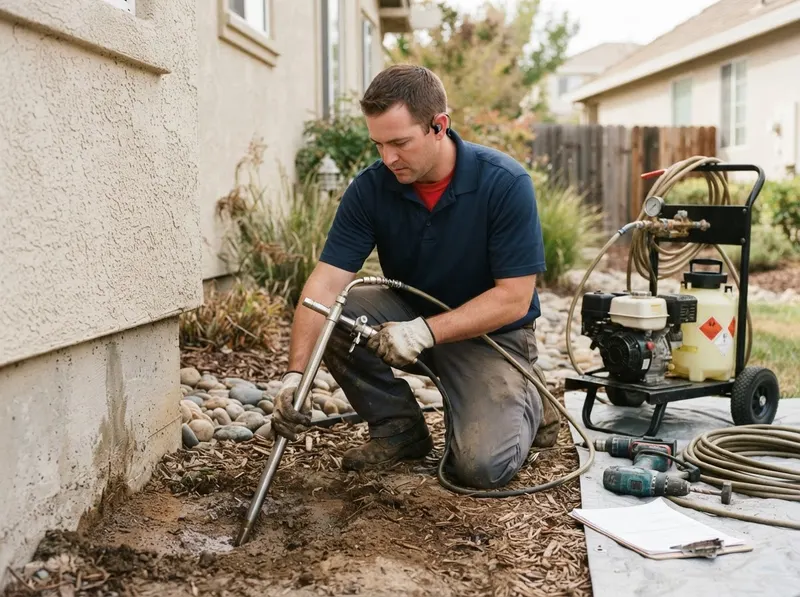
Subterranean termite soil barrier treatments establish an unbroken chemical barrier around building foundations. According to the California Department of Pesticide Regulation, structural barriers must be placed continuously along foundation grade walls to prevent subterranean foraging. The biological target in Sacramento County is the western subterranean termite (Reticulitermes hesperus), a native species that requires continuous soil contact to maintain critical body hydration. As noted by the UC Statewide IPM Program, subterranean colonies live underground and construct shelter mud tubes over stem walls and concrete piers to reach combustible wood members. Applying a non-repellent termiticide such as fipronil into the root zone alters this pathway; foragers cross the treated soil unnoticed, pass the active ingredient across their colony via grooming behavior, and eliminate the sub-slab nest within 60 to 90 days.
Subterranean termite barrier application costs depend on building architecture and the linear footage of the perimeter. A standard 1,500-square-foot crawl space home in East Sacramento or Curtis Park averages 160 linear feet of external wall plus internal foundation piers. Trenching soil 6 inches wide by 6 inches deep alongside footing walls consumes 4 gallons of mixed solution per 10 linear feet, as specified on product labels registered with the EPA Pesticide Product Label System. Homes built on monolithic concrete slabs in Natomas and Pocket-Greenhaven require specialized masonry drilling through patios, garages, and perimeter walkways. Technicians drill half-inch holes spaced 12 inches apart through concrete to rod termiticide directly into subterranean sub-base gravel, sealing each opening with structural hydraulic cement upon completion. While spot applications for small isolated patches start at the $200 service minimum, complete residential barrier installations typically run between $1,200 and $3,200.
Soil barriers provide immediate defensive perimeter coverage, serving a distinctly different role than surface wood sprays or bait stations. The National Pest Management Association emphasizes that liquid barriers bind directly to soil particles, remaining active through wet winters without depending on termite feeding preferences. However, clay-heavy soils along the American River Parkway and older parcels near Sutter's Fort State Historic Park require careful physical mechanical trenching rather than surface saturation to avoid chemical runoff, consistent with Central Valley Regional Water Quality Control Board environmental protection rules. If a property features extensive hardscape abutting the foundation, the trade-off involves drilling visible concrete surfaces versus the prolonged monitoring timeline of sub-surface bait monitors. Property owners must ensure ground-fault exterior lines are clearly mapped, as structural drilling requires compliance with OSHA trenching safety standards to protect underground utility feeds.
Preparation for a liquid subterranean barrier requires distinct operational steps. Homeowners must trim shrubs 12 inches back from perimeter stem walls and disconnect downspout extensions that discharge into the treatment trench zone. As regulated by the California Structural Pest Control Board, treatments near water wells or zero-lot-line structures require modified low-pressure sub-slab injection rather than deep rodding. Building owners can check soil safety data via the USDA Natural Resources Conservation Service soil survey to assess local drainage characteristics before application. TrueNorth Pest Management coordinates perimeter barrier plans using standards outlined by the ASTM International building standards and the National Institute of Standards and Technology for concrete stability. To review residential foundation treatments across Sacramento, call (279) 236-4097.
Every job gets a firm, written price after a free on-site visit.
For standards, safe disposal, and service guidance on PEST CONTROL SEVICE in Sacramento, CA, useful references include U.S. EPA, ENERGY STAR, U.S. Dept. of Energy, Consumer.gov, U.S. Census Bureau, and Google Maps. General consumer and small-business resources are available from USA.gov, Better Business Bureau, FTC Consumer Advice, U.S. Small Business Administration, and Ready.gov.
Tell us about your subterranean termite soil barrier treatments job in Sacramento and we'll send a clear, written quote, usually the same day.
 TrueNorth Pest Management