Residential bed bug eradication requires addressing the biological resistance of modern bed bugs (Cimex lectularius) to synthetic pyrethroids. Heating interior ambient air between 122°F and 135°F forces lethal thermal…
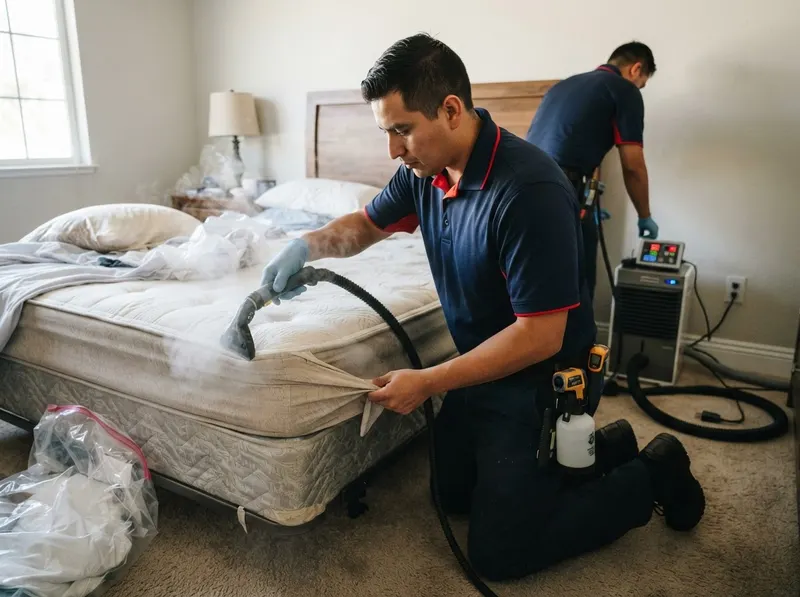
Residential bed bug eradication requires addressing the biological resistance of modern bed bugs (Cimex lectularius) to synthetic pyrethroids. Heating interior ambient air between 122°F and 135°F forces lethal thermal exposure into mattresses, box springs, headboards, and interior wall framing. Industrial electric and indirect fired heaters circulate hot air through ducted blowers, which monitored thermal probes track to ensure core temperatures stay above the lethal threshold for bed bugs established by the U.S. Environmental Protection Agency. In historic Midtown and Curtis Park bungalows where lath-and-plaster construction traps heat unevenly, high-velocity air movers eliminate cold pockets under subfloors and along exterior-facing baseboards.
While thermal treatment achieves a rapid knockdown of active populations and desiccation of unhatched eggs, pairing it with targeted chemical applications prevents future re-infestation. Technicians apply long-lasting microencapsulated residuals and insect growth regulators evaluated by the California Department of Pesticide Regulation along baseboards, door frames, carpet tack strips, and electrical plate interiors. Structural pest control operations in California adhere to licensing protocols outlined by the California Structural Pest Control Board. In modern slab-on-grade homes throughout Natomas and Pocket-Greenhaven, physical access along concrete expansion joints allows precise localized residual placement.
Pre-treatment preparation is required to protect household contents during the 6 to 8 hour thermal cycle. Residents must remove volatile items including aerosols, candles, vinyl records, crayons, oil paintings, and temperature-sensitive prescription medications. Electronics must be unplugged, and high-density foam mattresses need inspection before heating. Guidelines supported by the National Pest Management Association highlight that clutter removal directly correlates with lethal heat dispersion across dense furniture. Homeowners in East Sacramento and Land Park properties with extensive built-in cabinetry require thermal sensors inserted directly into interior shelf seams to guarantee thorough structural coverage.
Property owners evaluating standalone chemical options versus combined thermal and residual protocols balance speed against labor intensity. Chemical-only programs require three to four separate visits spaced 14 days apart to break the insect hatching cycle, requiring repeated furniture laundering and plastic sealing. Thermal remediation achieves immediate mortality within a single service day, supported by residuals that provide continuous protection against imported bugs. Municipal housing maintenance compliance follows sanitation standards enforced by Sacramento County Environmental Management Department, ensuring that multi-family and single-family structures meet residential habitability codes.
Every job gets a firm, written price after a free on-site visit.
For standards, safe disposal, and service guidance on PEST CONTROL SEVICE in Sacramento, CA, useful references include U.S. EPA, ENERGY STAR, U.S. Dept. of Energy, Consumer.gov, U.S. Census Bureau, and Google Maps. General consumer and small-business resources are available from USA.gov, Better Business Bureau, FTC Consumer Advice, U.S. Small Business Administration, and Ready.gov.
Tell us about your residential bed bug thermal and residual eradication job in Sacramento and we'll send a clear, written quote, usually the same day.
 TrueNorth Pest Management