Spiders migrate toward structural surfaces to capitalize on flying insect populations drawn to exterior illumination and microclimates. In Sacramento neighborhoods like Midtown, East Sacramento, and Curtis Park, mature…
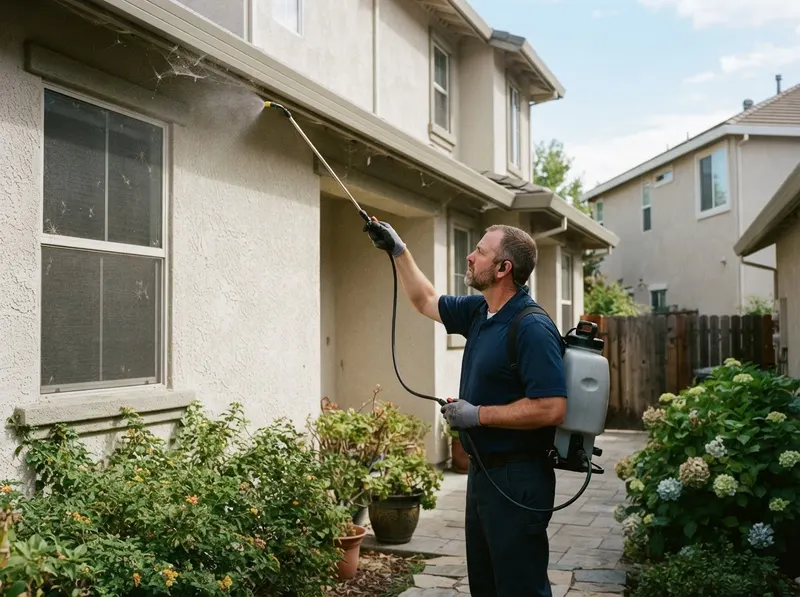
Spiders migrate toward structural surfaces to capitalize on flying insect populations drawn to exterior illumination and microclimates. In Sacramento neighborhoods like Midtown, East Sacramento, and Curtis Park, mature shade canopies combined with architectural soffits, wood trim, and deep porch overhangs create dense outdoor harborage zones. The primary species requiring suppression throughout the Sacramento Valley is the western black widow, which typically establishes low-profile retreat webs near foundation grade, gas meters, irrigation boxes, and exterior vent grates. In contrast, common orb weavers and funnel weavers set snare webs along gutters, under roof facias, and around exterior security fixtures. TrueNorth Pest Management executes mechanical sweeps using telescopic carbon poles fitted with static-charged brushes to safely dismantle active webbing, capture egg sacs, and remove desiccated prey fragments without abrading architectural stucco or painted surfaces. This physical intervention eliminates the structural anchor lines arachnids reuse across successive seasonal generations.
Effective web suppression requires targeting the secondary biology of the structure rather than relying solely on airborne treatments, as arachnids exhibit low grooming frequency and do not readily absorb standard contact deposits through their tarsi. Applying an exterior residual barrier along foundational weep screeds, window sills, and sub-eave junctions according to the guidelines set forth by the California Department of Pesticide Regulation ensures sustained residual action against crawling arthropods. In waterfront and river-adjacent tracts such as Pocket-Greenhaven and Natomas, midge and caddisfly hatches from the nearby Sacramento River corridor provide an abundant food supply that accelerates outdoor web reconstruction. Integrating perimeter barrier treatments with pest prevention practices outlined by the EPA Safe Pest Control program suppresses the underlying flying insect density, effectively starving residual populations out of sheltered eaves.
Decision factors dictate when standalone mechanical de-webbing is insufficient and comprehensive exterior barrier suppression is required. If exterior surfaces show isolated garden spider activity during peak autumn months, selective physical sweeping without chemical materials preserves beneficial predatory activity. However, when western black widow egg sacs appear within ground-level crawl space access doors, masonry voids, or children's outdoor play sets in Land Park, Oak Park, or South Land Park, full perimeter treatments are necessary. Standard treatments apply products evaluated under the National Pesticide Information Center standards to target exterior structural perimeters while complying with the California State Water Resources Control Board urban runoff containment mandates. Properties situated near dense public landscapes such as Sutter's Fort State Historic Park or William Land Regional Park experience higher re-infestation pressure from airborne spider dispersal known as ballooning, which makes scheduled maintenance sweeps every 60 to 90 days the most reliable defense against recurring exterior web buildup.
Every job gets a firm, written price after a free on-site visit.
For standards, safe disposal, and service guidance on PEST CONTROL SEVICE in Sacramento, CA, useful references include U.S. EPA, ENERGY STAR, U.S. Dept. of Energy, Consumer.gov, U.S. Census Bureau, and Google Maps. General consumer and small-business resources are available from USA.gov, Better Business Bureau, FTC Consumer Advice, U.S. Small Business Administration, and Ready.gov.
Tell us about your exterior spider and web suppression treatment job in Sacramento and we'll send a clear, written quote, usually the same day.
 TrueNorth Pest Management